Showing posts with label success. Show all posts

Thursday, May 24, 2012

Addressing first order problems with third order solutions

The sign shown in this photo is a none too uncommon sight in the restrooms of many places in the world. Necessitated by frequent blockages of the plumbing when coarse paper towels are flushed.
Placing a sign such as this might seem a solution to the problem at hand but does it address the root of the problem? Sure if people stop putting paper towel in the toilet the problem of the plugged toilets should go away, right? But did it consider why people go to the trouble of walking to the toilet with the paper towel to flush it?

When the problem is that people needed to use the towels instead of a more flushable media to "do their business", is this the most elegant solution? No. If the stalls never run out of favorable paper to use for the toilet duty, does that not keep the towels out of the loo?

In my other life as a sheet metal stamping plant process improvement specialist, we faced an issue where during part shipping "surface lows" appeared in some doors we stamped. The quality manager did a detailed study of the issue and narrowed the occurences to situations where the part was lifted from the conveyor in a certain matter. He wrote a SWI (standard work instruction) imploring the rackers to only handle the part in a certain manner to prevent the issue from cropping up. In fact the only way to fix the problem was to address the forming of the parts several operations earlier.


Now consider this applied to professional issues:
  • When quality issues in the plant keep cropping up; do we dim the lights in the inspection area (even dismantle it; yes, that really happened once). Or should we find the root cause? 
  • If warantee costs skyrocket; do we change the terms of our warantees? Or do we improve our product? 
  • When the scuttlebutt in the work place is critical of ones performance; do we ask the staff to limit intra-personnel discussions? Or should we mine the criticism as valuable fodder for improvement or change?
  • If the blank washer is leaving too many particles of "dirt and slivers" on the sheet metal; do we uninstall the blank washers? Or find the source of the impurities that the blank washer imparted to the sheet metal?

Take a look around your place. Are you asking your people to stop flushing the paper towel? Better look to the seat of the problem.

Thursday, August 18, 2011

Telecommuting: is it a good idea

As a consultant, employee, and manager I have often struggled with the topic of Telecommuting. Working from home was one of the "perks" of going independent for me years ago, the result was mixed: days and weeks cut off from humanity, with a dash of inefficiency, mingled with guilt and resentment on the part of my colleagues. 
Credit: Gawker.com via Lifehacker.com
In my own experience I had one job where the office was 4 hours drive from home, and I was the only employee who lived outside the city, state/province, country boundaries. Typically my job involved me calling on our customers on-site, performing training on-site, and supporting sales on-site. This was mostly a 3-4 day per week activity, with general administrative labor and follow-up being done from a "home-office"-the basement in my suburban rental home.
Credit realsimple.com
Other office staff resented the fact that I worked from home rather than and "office". The Solution? The Self-proclaimed-die-expert and Techni-ho was asked to drive from home to the office on the off days. Not just AN office, but THE office. So the policy was that if I had an off day, i would rent a car, drive to the office and "work" and leave when time allowed me to complete by drive before the end of the work day.

Correct. If I had one day off, I would rent the car, drive-in, walk-in eat lunch (on expenses) and leave for home (it made for just over a nine-hour day. Efficient? No, did it put an end to the debate over home-offices? Not really. It did put an end to my willingness to stay at that company, but created my first consultancy, once I was a consultant they no longer cared what I did on off days.

As we weigh the possibilities of allowing our staff to work from home one could unilaterally make an edict (usually not constructive) or just roll with it. In either case we might pay a price later. The Infographic below sums it up all very nicely (a little bit snarky but for the most part on the mark).
Credit: Mindflash
When you make the decision to either work from home or not, or to create an open policy for Home office hours. Be sure to have rational reasoning behind the policy. It can succeed, but only if you create the environment for it to work.

Treat your employees like grown-ups and they might prove worthy; treat them like children who can't be trusted you most definitely get what you expected. 

Thursday, July 28, 2011

Stereotypes, bias, and the mind

As a member of a culturally stigmatized group (Americans) in the eyes of many of the people I come into contact with while I travel for work. I found these designs by Yanko Tsvetkov highly entertaining. After all, I recognize that the we, of the much vilified USA, have earned our bad reputation. We often are loud talking, impatient, greedy capitalists.
From Yanko Tsvetkov's Mapping Stereotypes
Stereotypes of many Europeans that are held my Americans are not too far off the mark. Stereotypes and biases (cultural or otherwise) are an important part of how people work. With the amount of data that the typical person is confronted with daily, to process every decision, each interaction from a neutral stand point is a veritable impossibility. 

Monday, June 27, 2011

What can we do when the sales team accepts the customers Status Quo?

In a recent workshop with the sales and technical team of a small, yet significant CAE (Computer Aided Engineering) software company I was struck by the number of times that the sales team conceded that the "customer doesn't do it that way" so they don't see them changing methods.

Since when is selling about letting the status quo be good good enough? How about this? The status quo is that we don't get any revenue from the prospect, why challenge that in the eyes of the customer?

Ron Popeil never sold anything by accepting others view of good enough (image  wolfprint.stritch.edu)
Is it not the challenge for the sales person to convince the Desert Nomad to buy sand, or the Eskimo Ice, or the Lady in the white gloves want Ketchup flavored Popsicles? Then why, when I present the use-case for our software, do we roll over when the customer expresses that the model doesn't fit there current business paradigm? OK, if you say so. No need to grow our business. Have a nice day.

  • Since when has selling bee about completely ceding the value-arguments to our technical people?
  • Why is it so bad to challenge the customers feeling that "we are fine" without any change?
  • No, you don't tell them they've been doing it wrong, you just show them a better way.

If you don't believe that what your are selling is a needed improvement to the status quo, please move on; get out of the way of those who can offer change.

Wednesday, May 11, 2011

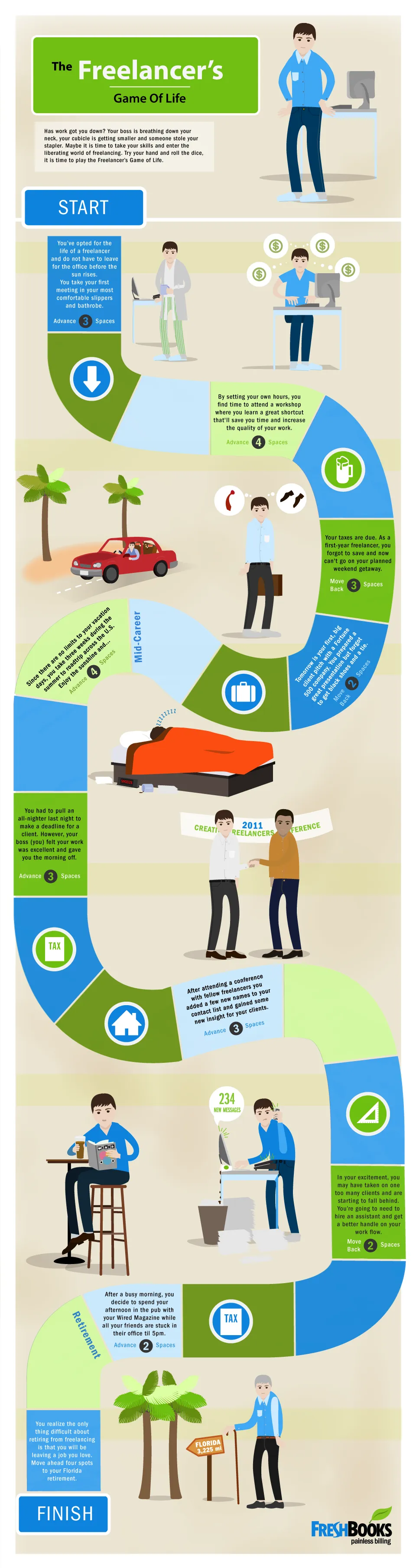
Infographic: the Freelancer’s Game of Life

The folks at FreshBooks posted this infographic on their blog.
Infographic: the Freelancer’s Game of Life

Of course it is fun to imagine that freelancing is all rainbows and kittens, but in the game of life there are often more pitfalls than the few move back # spaces possible landing areas.

  • You realize that taking vacation is the same as UNEMPLOYMENT lose 2 moves
  • Selling time for money means you never have any time move back 3
  • There are 24 billable hours in each day, land overseas account, tele-presence and move forward
  • Tax deductible is not the same as free, pay the bank $2000
  • Your non-equity partners make off with your account, move back 1 space
  • You finished the job, now get them to pay you, sit out next round
  • You need find a contract house to manage the project move forward 5 spaces
Being successful as a freelancer is still something that eludes most who try. I doubt there are stats out there, but I would not be surprised if more than 75% of freelancers have to resort to going native after the first 2 years. Having survived 7 myself before getting a J.O.B. it is not always a sunny as this infographic makes it sound. First of all, i don't know many freelancers that even know the meaning of retirement.

Thursday, March 10, 2011

The Birth of a Word: TED Talk 2011

TED talks are amazing places to watch, hear, learn, and discover some of the most amazing things. From Deb Roy's presentation on the Birth of a word it is tricky to force oneself to get over the technological tricks they had to invent to perform this research (video correcting 10+ fisheye video feeds into a near 3D representation of Deb  Roys home that can allow us to follow him, his wife, their son and the nanny through their house for a few years) to discover the patterns in that lead to the successful emergence of word use.


Had to watch this a couple of times before I could let the point of it, sink past my utter amazement as to HOW they parsed it, to what they found. The 120 Terabytes of data, the linking of the various feeds into a single cohesive (and virtually 3D) time space environment. And get where it was going.

The space time tracking of movement in the video to find the feeds where they could locate his sons specific word use. the ability to get audio transcripts from disparate video sources into a coherent "stream" of communication. This turns into different methods of tracing the communication threads throughout our society and our social structures.

Not sure what it all means yet, but to quote Deb Roy and son.   "wow"

Friday, March 4, 2011

Careful the legacy you leave

Here's a funny story with only a small moral:

The engineering director of a medium to large tool shop paid a call on his former employers, now customers. He stopped by the desk of the administrative assistant to ask if she would note his arrival for his appointment which was set to start in 15 minutes, and if possible announce his presence to the Mr. Big the chief of this operation.

The conversation went a little like this [slightly altered to protect the ignorant]:

"Hi, I'm Bob Namechanged. I'm here for an appointment with your boss, Mr. Big."
"Oh? And where should I say you are from Mr. Namechanged?"
"Tool and Dieshop Inc."
"Oh, good. Be sure to mention that you are from Tool and Dieshop Inc. Because we used to have a guy here named Bob Namechanged too. But nobody liked him. Apparently he was a bit of an A-Hole."


What on earth did Mr. Namechanged do while at his former employer to earn this reputation?
How surprised he and his new colleagues must have been to find that his relationship with the old shop was not rosy; no doubt expectations of a healthy relationship may have even been part of his hiring at "Tool and Die Inc."

We must all be careful of the legacy we leave behind. The world is getting flatter and as Kevin Bacon will attest we are all only 6 degrees of separation from anybody else.

Wednesday, January 26, 2011

Fun makes the stairs more appealing [video] - Holy Kaw!


It should com as no surprise that if you want to get people to embrace change, that injecting a little WiiFM like making it fun will have a positive effect on the unstated change initiative the VW was attempting (they wanted to prove that fun made it worthwhile). Also the fact that they did not tell people that they were trying to alter their behavior increases the (i) perceived input. It was their idea after all to enjoy the musical step.

Re-Blogged from AlltopFun makes the stairs more appealing [video] - Holy Kaw!

Sunday, January 23, 2011

poor video from the Technopark presentation

Tried to capture some video of the presentation, but unfortunately the batter on the camera is pure crap. In any case I salvaged some video thanks to Roald who saw the camera stop.

Thursday, January 20, 2011

Brown Bag Lunch: Selling Innovation/Change

I made the presentation, but unfortunately my camera has such a disappointing battery that I have not video of the talk. But here is the slide show instead. I post via slideshare.


Since the talking I do is not captured, I have to make sure that I give credit where it is due. Also, for more places to see, things to read, or inspiring voices you can look up:

  • Simon Sinek, Start with Why (the what, how, is not original)
  • Dan Ariely for the comparative difference thought starter
  • mondaydots for first showing comparitive difference to me, and planting ideas for the simplicity of the presentation

Thursday, October 28, 2010

Performance Measurement

It is a painful period in the growth of youngish companies, from that of a start-up to that of a SME (Small Medium Enterprise). With this transition come many growing pains come many challenges:

  • how do we measure ourselves toward our goals?
  • what goals are worth following?
  • what happens if people don't meet these goals/expectations?
  • are the people who go us this far still the people we need tomorrow?
Plainly, you get what you measure and you measure what you get.


If your goal is not measurable it probably is not objective (knowledge, faith, confidence are all highly subjective but too often in peoples goals).

Goals should link to our bottom line, short, medium or long term. After all, if it doesn't help us ,make money it can't really be that strategic (I recently heard a person remark that strategic is often used as a euphemism for not profitable).

Have to be willing to call people to the carpet if the goals are not met, and that includes making very hard decisions linked to the last question.

The people who may have gotten you out of the gate might not be the people who should take you all the way into port. Just like the people who you need right now, might not have been the right people when you were boot-strapping the business.

One of my acquaintances, recently on noting that many of their companies technical staff might not be up to snuff on some of our more recent offerings, asked what would happen if we were to institute a "testing" or "assessment" of skill and capability. Unfortunately, my answer was that we would first have to decide what we should measure, what would make a good technician? And for that the company is still, not out of the dark.

Sunday, October 24, 2010

Customer Service = untapped oppurtunity

Recently Simon Sinek posted a view regarding Customer Service Re:Focus: You Shouldn’t Need To Wield A Gun To Get Customer Service. There he asks:

My question is, why do I have to hold a proverbial gun to a company’s head before I get a decent level of service.  That's not good customer service...  
 Customer service is when a company works everyday to keep your business so that they never face a threat of losing it. 


Each call from a customer represents an opportunity, to further your position with the customer or go backward. One truth to consider when putting together the customer service philosophy at any business is to remember there is no benefit to the idea that customer service is about maintaining customers. In business, you are either growing or shrinking, but generally you cannot ever hope to stay the same. After all, staying the same means you are losing to the people who are growing--even modestly.

If the phone rings at customer service, you already have what is most likely an incipient disgruntled customer--an embryonic pissed of user, or future flame mail sender, or angry blogger in the making. It should be your mission to convert that call into a [insert your company name here] super fan, Facebook fan, or follower.

It is an opportunity to interface with your customer, one who took the time to call you (before they voted with their wallets and feet). Embrace that opportunity and make it matter, instead of looking at it as a chore.

Tuesday, September 7, 2010

Why working at home is both awesome and horrible - The Oatmeal

My big  brother, a long time Techni-HO, was recently cut loose from one job and landed another. His new job has offices in "CheezHead-land" while he resides in "West Mittenton". One aspect of his new position is that he is the lone Mittentonian employee and will be working from home.

Matthew Inman (a.k.a. The Oatmeal) recently made another brilliant comic that addresses the situation. Why working at home is both awesome and horrible - The Oatmeal

For my bro, and others in similar positions I offer my advice; culled from a few years of personal failures
  1. Behave just like the home office is still at "THE OFFICE"
  2. Commute 
  3. Keep regular office hours
  4. Leave the home office 
  5. Find an office space

1. Behave just like the home office is still at "THE OFFICE":
Many people are tempted when envisioning the Home Office of the glory of being able to work in ones undershorts. This is IMHO a big mistake. Break from home habits;  Shower, groom, and dress just like you are going to the "Office". Make a mental start to your day by following the exact routine you would if you had to meet with the boss at the main office, avoid falling into lazy patterns that you will have to unlearn later. Additionally, you start the day prepared for that late call to head out to customer site.

2. Commute 
To assist in the break from home habits to work habits give yourself a commute; even if it is only a walk around the block or a short bike ride. Mentally gather yourself for the working day and make a clean break from the home front.

3. Keep regular office hours
Determine when you are on and off the clock and stick to it (at least try). Set expectations among your co-workers for when you are working and when you are not. Follow repeatable and predictable patterns. If you don't like having the Hong Kong Office call you at 7:00 PM then don't send them emails at that time, or call them on the evenings that you are breaking office hours. You are most likely not getting paid for a 24-hour day so don't work one.

4. Leave the home office
Otherwise you will always feel like you are at work and never be able to relax even on holidays and weekends. That is the curse of the home office, you never leave work. Consider setting up an alternative phone line as the "Office line" (get one free from Google if you have to). And have people call you there during office hours; leave the home phone unanswered during business hours and do the same for the business line during off hours. If you make a clear distinction of office time to home time others will follow the lead.

5. Find an office space 
Working from home is no picnic and makes being home less enjoyable sometimes. Make an office space specifically for work; Rent one near home, set up shop in the library or Coffee house, or set aside space in your house ONLY for that purpose. I find it impossible to leave the work behind if my workspace is the Kitchen Counter or the same computer desk I sit at for chatting it up with buds on the Social Net. Likewise, it is hard to get to work in the space you also use for leisure.

Good luck if you are making the move from Cubicle Hell to working from home. But make sure you set yourself up to be successful in both walks of life--by keeping them as separate as possible.

Thursday, August 26, 2010

Creativity Malaise?? Time to road trip!

A friend of mine recently shared this observation about his start-up:
the most frustrating part of it: we have difficulty finding time to sit together and "reinvent the world/future" of the company. Probably a lack of oragnization, and certainly too many things to do, which in itself is a good problem to have I must say. (Mathieu, you did sign that disclosure agreement? Didn't you??)
My suggestion. Take a Road Trip, and do it now.

Why?

When Mathieu and I worked together, we used to have to drive 4 hours each way to get to customer and prospect demos. On those drives we used to bubble up some of our best ideas, practice our spiel, get good at verbalizing the raw and unformed ideas, and generally have a great time in doing so.

On the way home we would debrief the demo then, fall back into the creative BS line we had on the way out, and try to imagine what we could do next.

So, Mathieu set an appointment (real or imaginary) to call on a prospect about two hours outside of Marseille. On the way out just get the ideas out there, make the sales call (or if you are inventing an imaginary one set your phone to call you shortly after you arrive to have the prospect cancel on you); Then use the ride home to make action items from any ideas you had on the way out.

Might as well make the trip worthwhile.

Sell the problem (borrowed from Seth)

In a recent post Seth Godin suggests that we need to be good as selling the problem (before we can sell the solution).


Getting your clients or prospects on the same page as you, by demonstrating your understanding of their pain, and then suggesting that you have a remedy to that pain is one of the keys to successfully changing them from prospect to customer.
If the customer does not at first recognize the problem or pain the resistance to change is certain to go to infinity. If we do not have a reasonable alternative to the current situation that too sets the resistance to infinity.

Both points Seth is good enough to mention in hist blog. But I would add that we cannot forget to include the ever important W.I.F.M. (what's in-in for ME) and the desire to feel that it was their idea.

Get them on board with the problem, present them with a beneficial alternative, that makes the individual succeed as well as the company and let them THINK it was their idea.

Thursday, August 12, 2010

My Grade Point, and S.A.T. Scores? REALLY

While trolling about the internet and the number of Social Sites I use: LinkedIn, FaceBook, Buzz I stumbled upon a job listing for Google. Looking for somebody in the Sales Department in Mountain View to do Partner Sales-Technical Account Management.

I followed the link and filled in my first GoogleJobs application/resume/posting. Now I am a little disappointed that I did find that I had to post my G.P.A. which is really quite poor (2.72 I think I actually have long forgotten what my G.P.A. was) and My S.A.T. Scores (I recall that I had an 1100 +/- 50 points), but that was 15 and 22 years ago.

Just how these metrics track to the potential I have to support a company like Google, is well beyond me. In fact, I am quite certain they are well beyond relevancy. The only interesting thing about my grades in University is that I got them, and they let me out anyway; And that since then I have been employed, despite them, and succeeded well beyond what some people would have assumed possible with those types of numbers.

Maybe more important would be the trend (not visible in a single number) of the Grades:

  1. 3.0 freshman
  2. 2.0 sophomore
  3. 1.2 sophomore
  4. 2.2 junior
  5. 2.7 junior
  6. 3.1 senior
  7. 3.2 senior

But then I would have to expose that I was a really poor student at first, then a lost student for a few years, but finished (a miracle on it own) and actually finished strong, once I found my niche--Technical Training and Communication about Technical Content. Oh and yes, that is just under 7 full years to graduate from Michigan Tech (which in my defense has accepted the fact that they are a 5 year school, and that explains at least 1 of the extra years).

What makes good employees after all?
  • Grades? (not good for me)
  • Test Scores? (not great, but not bad)
  • Good looks? (Rats!)
  • Height? (Ouch, that would suck)
  • Ability to survive adversity? (Hey, I used to suck but look at me now!)

I hope that Google, or whoever we try to find work with in the future, will recognize whether or not they are creating for themselves a "quarterback problem" when trying to fill their jobs. At least long enough to get our foot in. At least then the rest is up to us in the present--just how it should be.

Wednesday, June 30, 2010

Seth's Blog: The sugar cane machine

A small island grows sugar cane. Many people harvest it, and one guy owns the machine that can process the cane and turn it into juice.

Who wins.....


Another simple but worthy parable from Seth. If in a market that has reached a competitive parity, competing on price or efficiency can only get you so far. At some point the differentiation needs to come from something else. Something the other don't have, don't value, and haven't thought of.

Finding that thing for you and your company will never be easy, since after all, if it was easy to recognize somebody would have already started.

Friday, June 25, 2010

Leadership Equals:....

Simon Sinek posted recently, Re:Focus: The Best Leaders Teach Others To Lead.

In too many places management has replaced leadership as a value. To manage implies that those around you require outside influence to do even the most ordinary and mundane things (i.e. shepherds have to manage their flock. If not the sheep wander off, fall down holes, and get eaten by wolves).


Leadership, implies that the "flock" chooses to follow. Leaders are often selected by the "lead". So when we build a culture around leadership, the leaders as well as the leader should aim to do the right thing and go the right way because it is just that the right way. Leadership, is not a carrot and stick mentality but one where-in the motivation comes from within.

Ideally, the leader inspires the lead to become the next leaders. Managers, never inspire little else but dissent.

Monday, June 21, 2010

mondaydots: Information Gap

Jeff Monday @ mondaydots makes another simple elegant explanation of ideas. This time from the Theory of the Information Gap and how to use it.

In reading "Driven" & "Made to Stick" I stumbled across an incredibly interesting idea. It's called Information Gap Theory. Dr. George Lowenstien wrote a paper about it in 1994 and it works like this: when we come across something new that is not explained by our previous knowledge or experiences, an information gap is formed. If you are a designer, creator or communicator, understanding how to use this gap will have great rewards.

Saturday, June 12, 2010

SethG: 16 questions for free agents

Seth Grodin's Blog recently post the questions that I had long sought to consider in this blog. But of course since he is Seth and I am not he gets props for saying to more people. I would however like to consider his post:

16 questions for free agents

1. Who are you trying to please?
2. Are you trying to make a living, make a difference, or leave a legacy?

8. Which: to invent a category or to be just like Bob/Sue, but better?

11. Choose: teach and lead and challenge your customers, or do what they ask...

15. How close to failure, wipe out and humiliation are you willing to fly? (And while we're on the topic, how open to criticism are you willing to be?)
16. What does busy look like?

I wish I had posted it first, but it is a good list.
Check out Seth's Blog or search here for other consulting and free agent suggestions.