Showing posts with label consulting. Show all posts

Wednesday, May 11, 2011

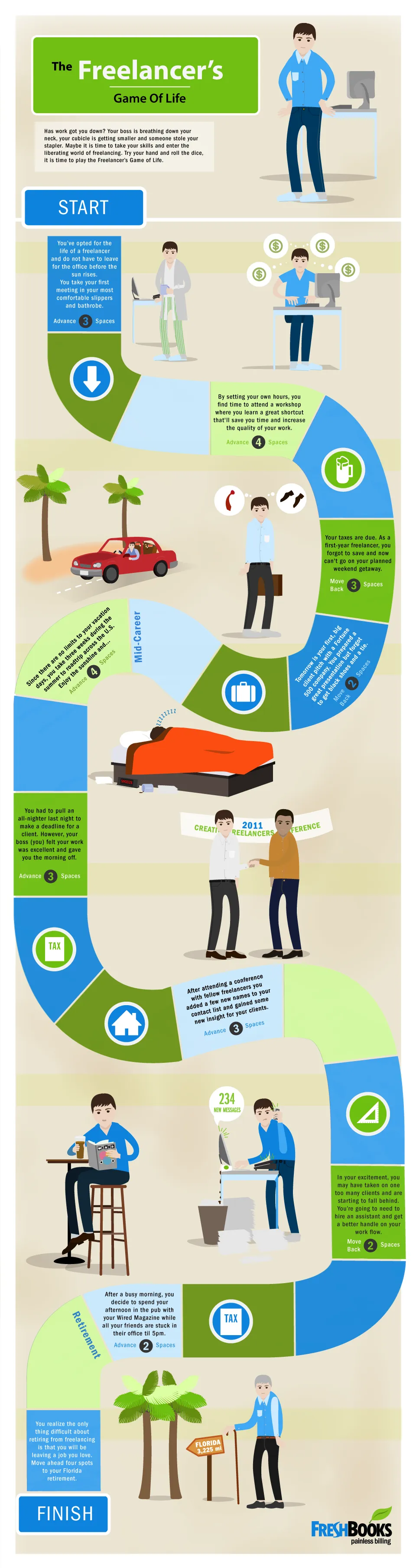
Infographic: the Freelancer’s Game of Life

The folks at FreshBooks posted this infographic on their blog.
Infographic: the Freelancer’s Game of Life

Of course it is fun to imagine that freelancing is all rainbows and kittens, but in the game of life there are often more pitfalls than the few move back # spaces possible landing areas.

  • You realize that taking vacation is the same as UNEMPLOYMENT lose 2 moves
  • Selling time for money means you never have any time move back 3
  • There are 24 billable hours in each day, land overseas account, tele-presence and move forward
  • Tax deductible is not the same as free, pay the bank $2000
  • Your non-equity partners make off with your account, move back 1 space
  • You finished the job, now get them to pay you, sit out next round
  • You need find a contract house to manage the project move forward 5 spaces
Being successful as a freelancer is still something that eludes most who try. I doubt there are stats out there, but I would not be surprised if more than 75% of freelancers have to resort to going native after the first 2 years. Having survived 7 myself before getting a J.O.B. it is not always a sunny as this infographic makes it sound. First of all, i don't know many freelancers that even know the meaning of retirement.

Sunday, January 23, 2011

poor video from the Technopark presentation

Tried to capture some video of the presentation, but unfortunately the batter on the camera is pure crap. In any case I salvaged some video thanks to Roald who saw the camera stop.

Thursday, January 20, 2011

Brown Bag Lunch: Selling Innovation/Change

I made the presentation, but unfortunately my camera has such a disappointing battery that I have not video of the talk. But here is the slide show instead. I post via slideshare.


Since the talking I do is not captured, I have to make sure that I give credit where it is due. Also, for more places to see, things to read, or inspiring voices you can look up:

  • Simon Sinek, Start with Why (the what, how, is not original)
  • Dan Ariely for the comparative difference thought starter
  • mondaydots for first showing comparitive difference to me, and planting ideas for the simplicity of the presentation

Wednesday, June 30, 2010

Seth's Blog: The sugar cane machine

A small island grows sugar cane. Many people harvest it, and one guy owns the machine that can process the cane and turn it into juice.

Who wins.....


Another simple but worthy parable from Seth. If in a market that has reached a competitive parity, competing on price or efficiency can only get you so far. At some point the differentiation needs to come from something else. Something the other don't have, don't value, and haven't thought of.

Finding that thing for you and your company will never be easy, since after all, if it was easy to recognize somebody would have already started.

Wednesday, June 16, 2010

How not to solve problems


I wish there was some higher lesson in problem solving I could offer as a moral here, but instead I am stuck between laughing and crying.

Saturday, June 12, 2010

SethG: 16 questions for free agents

Seth Grodin's Blog recently post the questions that I had long sought to consider in this blog. But of course since he is Seth and I am not he gets props for saying to more people. I would however like to consider his post:

16 questions for free agents

1. Who are you trying to please?
2. Are you trying to make a living, make a difference, or leave a legacy?

8. Which: to invent a category or to be just like Bob/Sue, but better?

11. Choose: teach and lead and challenge your customers, or do what they ask...

15. How close to failure, wipe out and humiliation are you willing to fly? (And while we're on the topic, how open to criticism are you willing to be?)
16. What does busy look like?

I wish I had posted it first, but it is a good list.
Check out Seth's Blog or search here for other consulting and free agent suggestions.

Tuesday, May 18, 2010

Creeping Determinism

Listening to What the Dog Saw: And Other Adventures by M. Gladwell and just got the part where he discusses the concept of creeping determinism, where he highlights the pitfalls of the many post-mortem analyses that people do of well documented outcomes and the way people seemingly fail to "Connect-the-dots".


Gets me thinking about how we spend mountains of time and effort dissecting computer simulations and analyses and models after the fact and point fingers at what people did not see. But we rarely talk about the other things that were in the view as well. The mountains of other data and circumstances, and boundary conditions of the day we first do the analysis and interpretation.


Brilliant stuff.... but it hurts my brain a little.

Saturday, March 20, 2010

Freelancing: Techni-HOs unite

In a recent post Seth Godin ("the Dip" Dude) covered a favorite topic here Freelancing and Value they provide. Sure we often reduce the bottom line (we have lower overhead than those who are part of the SYSTEM; but they often overlook the value of being from outside the mainstream and the passion that freelancers have for their chosen Vocation (just the fact that they live off it makes the a in avocation silent).


Hire based on passion when passion matters, if cost comes along for the ride even better.

http://www.typepad.com/services/trackback/6a00d83451b31569e201310fbb6b13970c

Thursday, March 18, 2010

Consultant Value: the outsiders POV

Why we people need consultants? What Value do we provide?

At one customer site an Shift Supervisor who we regularly bumped heads with (constructively it turns out) stated very clearly that the problem with us is that we did not have to live their lives (consequently that was one of our strengths). The outsiders perspective allows for a alteration of the context that any given problem can be viewed in.


For me this was made more relevant by this video example of "predictable irrationality" from Jeff Monday and

Mondaydots.com and my subsequent listening to Dan Ariely's book by that name.

The ability of the consultant, or any voice of an outsider, breaks the pattern of the relativity that often blinds ourselves to the irrational decisions we make.

It is not necessarily that consultants have better insights because they are who they are, it is often times that they come to us without the baggage of our organization.

Additionally we risk upsetting this balance when we internalize that consulting function. External Change Agents are value added.


PS the reading by Simon Jones in the Audio Book is FANTASTIC it adds great dimension to the book, with a very crisp delivery of the irony of peoples predictably irrational behavior.

Wednesday, February 3, 2010

Resistance to Change: The empirical formula

The old joke is: 
How is arguing with an engineer like wrestling a pig in mud? 
After a few minutes you realize the pig likes it.
In order to facilitate change (what we consultants; internal or external) all hope to achieve, we must first come to terms with the fact that it is human nature to resist change. If we are selling organizational change (Who Moved My Cheese?), technology change, or process change (The Machine that changed the world) we must overcome the human urge to keep things the same.

A few years ago my good friend Bob Murdy and I first wrote down this formula (or something like it). There are a few key factors we always liked to point out in this equation. First, the benefit to the company or the team or mankind has no place in this equation (directly). Some people could however assess a positive value for gain from helping their fellow man because they "feel good" to help others. That is a selfish motive (just think of all the people in the world who don't appreciate the helping hands we offer them (Aztecs, native Americans, and Australian aborigines come to mind).

Additionally, the pain might be no more than my own guilt that must be assuaged (i feel bad for being a materialistic pig, so I text some money to Haiti and I feel better.

With this equation, we see that it only takes one missing element in this equation to make the whole thing (resistance to change) go to INFINITY. (division of any number by 0 goes to infinity for the non-math types out there).

So why don't people accept change:

  • They feel no need to change
  • You gave them no personal benefit
  • You gave them no choice
  • It was not there idea

Monday, October 26, 2009

Consulting: Failure is an option!


Pretty poor paraphrasing, but still on point. When outlining a project with your clients one must ensure that any "failure" is, in fact, success. A common mistake that dooms many engineering consulting projects is the failure on the part of the Techni-HO in question from recognizing that sometimes they may successfully arrive at an answer of "NO".

This is different from prior discussions on the concept of "Shooting the Moon" Guarantees earlier mentioned here. But instead a need for you the Techni-HO to be able to recognize a no-win situation long before it ever happens.

For example, a common engineering problem in my other life as a Self-Proclaimed-Die-Expert is Formability and Springback. I'll pick on formability since it is the easier one. Some of the early tricks in my career relied on my forming "expertise" to identify and correct forming issues. These forming issues were usually automotive sheet metal parts (big body panels, exterior and under body) that split. Of course, producing fenders for Cadillacs and hoods for Oldsmobiles that had big splits in them was totally unacceptable.

The idea was to make the splits go away. It was our roll to make them go away, but here is the trap, what if the splits can't go away? What if there is no solution to fully resolve the failure? We always had to be careful not to take too much ownership in the absolute execution of the solution. For if the suggested solution does not resolve the problem then what do you do next?

We tell them that to make the splits go away they need to reduce the strain in that area x%. By definition in sheet metal the split is an indication or symptom of excessive strain. It would be a mistake to point out that they need to increase or decrease some specific variable to fix the split. (unless you are very good at recognizing the "moon-shot" opportunity).

Carefully craft your solution. The good news is that many of your customers won't recognize restatement of the problem, as a failure to solve the problem.
Return to profitability, by bringing revenues and expenditures in balance. (no shit!?!)
The "HOW" is for the process stakeholders (your clients) to decide and implement. Help them use process to identify potential solutions, help them to implement, then be ready to be the one to measure the success of the change. Just be smart enough to say, "that didn't do it, but we are headed in the right direction. Or that was wrong, now we know it is not related to [yada yada yada]."

I hope you never promised that a specific implementation would achieve the required end. After all, a plausible solution might not exist for their given parameters. However, we may eliminate a plan that did not work, and that has value.

Friday, October 2, 2009

Consulting tips: drink the kool-aid, believe and practice what you sell

As a Techni-HO you probably from time to time will have to advocate strategies and practices that in previous life seemed abhorrent to you. After all, you collect fees from clients to serve them and not yourself. Similar to the power of "we" "drinking the Kool-aid" is a highly necessary and powerful consulting tool that one must develop with prowess if one is to succeed.


The easiest thing is to only do and support the ideas that you believe, however if life was that easy we wouldn't need "blood sucking parasites" like consultants in the first place. So the next best strategy is to find the little things that work and apply them to your consulting work whole heartedly to the point of near fanatacism. One example for me was 5S and the visual workplace. I am a sloppy person I thrive in a certain level of chaos in my desk and car. So when the project I supported started promoting 5S it really was a moral dilemma (I ran work shops teaching the methods that I could not truly support personally). The work became painful, dull, and irritating.

In order for me to get through I started 5Sing (not really a word?) Everything; fanatically- my desk, the drawers, my car, my entire on project existence (I went so far as to mark out a place for my mug and the cord of my phone) once I was fully entrenched into the overzealous application of the method, I found humor and fun in my madness. Since the coffee cup could never make it back to the right spot, I glued a coaster with the green boundary around the base and properly labeled "Kam's coffee mug".

This mis-application of the method showed a very entrenched knowledge of the system to my "trick" and taught me to believe in what was useful about the method and where to draw the line. I started to believe, after that the training was better for them and me. Drinking the Kool-aid required the leap of faith on my part and in doing so - gained the trust of my client. Which was truly the problem at the beginning they could see I did not practice what I preached and may have been flogging the flavor of the month.

Now the world is filled with more systems (lean this and that, green initiatives, and new flavors of the month) take a step towards the edge, embrace the dark side, and drink the Kool-aid. Otherwise you are merely "whoring".

Eric Kam, broadcasting from an undisclosed location via BlackBerry

Friday, September 25, 2009

Consulting Success Guaranteed!!! 3 steps to promising RESULTS

When delivering technical consulting the slippery slope we all ride is the risk that our expertise may ever lead our customers astray. The fear that our credibility, our reputation, and future are on the line with every piece or distilled techni-HO wisdom we send out in the world. We have to be bold with our promises but of course must hedge everything.

The delicate balancing we seek is provide the over the top promise of a brighter future that will open up our clients wallet, while not exposing our soft underbellies to the risk of failure and and future destitution.

  1. Define finite and feasible goals
  2. Speak to the customers pains/needs
  3. Shoot the moon


First, finite goals. Many an engineering project has gone astray because the consultant has promised something that cannot be delivered. Recently that has included, develop "Robust Compensation plan for production stampings" (remind me to blog that out in the stamping blog), design light weight rechargeable batteries for hybrid cars, and develop sustainable cold fusion. Now, why are these examples of bad promises that don't meet the criteria of finite goals?
  • an acceptable result might not exist. For those who know anything about stamping (go to other blog to learn) it is possible the ideal result is not there. And now our client might expect it
  • defined goal is relative (who says what is light weight?)
  • The goal may be totally unattainable, or if they are it takes too long to get there
Instead, the goals must be finite and achievable on a time line. Don't promise the result but perhaps the enablers to the results, "establish the process and install the technology for achieving robust springback compensation." This is achievable. We know how to install the process, we can define the process and needed technology. There is less chance of bloat in the scope.

Second, speak to the customers pains/needs. With this we need to put the benefit in front of the customer immediately, so that it is clear what they gain by paying our fee (also establishing the disproportionate value statement needed for the Win-Win). "Install the process and technology for achieving robust springback compensation, for a potential reduction in tryout time of 50%" this particular type of promise is very nice as we promise the installation of a process and new technology which is very provable and measurable, and link it to a benefit that is not entirely measurable, since if they do follow our process they can never know what the entire exposure was. i.e. "Imagine how long it wold have taken otherwise..."

Third, Shoot the moon. Shooting the moon is the tricky one, it requires being big and flashy and very much covering your bottom. What I mean by "shooting the moon" is a way to Guarantee Success. Yes, Guarantee success, onto which you can put any type of promise to the customer. 100% refund, slavery for life, your first born. The "shoot the moon" guarantee works like this. Your promise what you mention in 1 and 2 above of the delivered results promise, then guarantee the result IF ________. The "if ________" is where you all will earn your true techni-HO stripes in knowing what the key if is. It usually involves something like "do what ever i say", but can't be that transparent. Most consulting clients should be smart enough to spot a bad guarantee like this but maybe not. Most of us fall for it regarding lifetime warranties on anything we buy. Lifetime satisfaction guarantee (just keep the receipt, the original packaging, never get wet, and NEVER FEED AFTER MIDNIGHT.)

Shooting the moon, requires a highly insightful knowledge of your customer, and knowing exactly how they will self destruct your and their hard work. I call it shoot the moon for this simple analogy.
I can promise any nation on the earth that they can become a world economic super power if they follow me advice and with my assistance put a man on the moon. Satisfaction guaranteed.
Finite and achievable, speaks to need and desire, and has an escape clause. Because truly, any nation no matter how small if they manage to put a man on the moon, they probably were already a world super economic power, my idea just got them the recognition. Those are results and i get paid.


Thursday, September 24, 2009

Organizational dynamics, the Techni-HO and an awkward analogy about religion

Let's see if we can stir the pot a little bit.

I have noticed as i ventured from company to company interesting trends among the employees and employers of the various places i worked. This one I will call "Finding ones religion". When many a re born they enter into religion (not by their own choice but by the choice of their parent, community, or national standards). This is much like your first job. You have a traumatic and disorienting experience (birth=college graduation), and leave the isolated and protected environment you knew (womb=university) and enter the WORLD.

In this world you find shortly after birth a community of seemingly welcoming individuals. These individuals follow some sort of code, or tenets, or dogmatic teachings that as far as you know are the way of the WORLD. There is no other way, why would there be, this is how it is. For a great many people this world order is great, there is no reason to challenge it, and we work and work happily in this our natural born religion/company.

It may happen the over time we either leave the "church" or it leaves us (down sizing = excommunication, quitting = schism/reformation). Left without the grounding of this religion/job we are forced to find another way in the world. This new found job (born again = rehired) offers for us a new salvation from doom and destitution. And we welcome the new teachings of this place as mighty and righteous as it is clear that this is the path to salvation. Born Again.

Perhaps here we find long lasting peace and tranquility. However, for many the possibility still exists that we have not found our home. And again either through heretical thought or action, or ostracism by the organization we find ourselves out in the cold with neither faith nor community. Yet all is not lost and we again can find something to believe in (or at least something that we can latch onto). But now wiser and perhaps a little jaded we learn to live with the imbalances brought out by the dogmatic beliefs of those around us, we learn which ideas or thoughts will not spark heretical criticism, and we take what we can from the experience (nirvana, enlightenment, independence).

What does this have to do with being a techni-HO? Being a former trainer (and a damn good one at that) i tend to speak in analogs; this is no exception. These i hope can serve as archetypes for learning how to deal with those we work with/for out in the world. There are the neophytes (those born into religion/company), the born-again, the pilgrims, and the missionaries. Techni-HOs tend to be missionaries, who after years of pilgrimage will amass the wisdom of the Buddha and be able to bring the light to the neophytes. But their really is nothing more difficult than the born-again who believes they have seen the world and know what time it is.

we'll see where this takes us? (actually just me, since nobody really reads this blog)

Wednesday, September 9, 2009

You TOO, can be a Techni-HO


We embark on the Techni-HO journey for many reasons:

  • Downsized
  • Desire for independence
  • Desire to go broke
  • Hubris
  • Ego
  • Fired for inability to conform to authority
  • We don't fit in anywhere else
Couple this with a belief that what we have to offer is of value and we are on our way. My personal journey into Technical Consultancy was perhaps destiny or purely accidental. I am an engineer of low-regard who barely scraped my way through engineering school in 7 years (without a Masters or PhD). During my senior year I took a job with a technical training company as an engineering Co-Op student. The attainment of this job taught me the first of many lessons that I plan to impart to any viewers of this blog (once we get enough traffic, clicks and impressions).
Lesson 1: There is value in being a Bad Engineer (or insert your profession here)
As a poor engineer I had lots to offer to my prospective clients:

  • I learn slow (so I have to ask lots of questions)
  • I am accustomed to failing (a needed skill for consultants people who succeed often never adapt to the idea that their ideas might flop and are often afraid to suggest things)
  • I have the ability to overlook seemingly important details (a skill that all successful consultants must have).
In the realm of technical training, where I got my start into consulting, one learns quickly that you don't need to be very smart to be a highly successful trainer. No on the contrary we learned that in order to be good we only had to know more about the defined training topic than the students. Now we find that good engineers (or technicians) tend to have broad working knowledge of the systems in which they operate. Which can be very threatening to the consultant, but have no fear. Because you will be able to dazzle them with your brilliance in ONE or TWO areas of discussion. Which fortunately, is why they hired your or signed up for your class, or contracted your firm.

The take-away
The consultant Must be singular of focus, they must be willing to put aside other performance attributes for the SINGLE thing the customer asks (pays) for. Good engineers, or technicians, under the employ of the customer might accidentally see the shortcoming of a decided course of action as detrimental to the larger organization. But a consultant (being unburdened by this knowledge or moral compass) will determinedly pursue defined objective even if the long term benefit might not be there. After all that is what we hire them for. Short term gains. That after all is why we hired the techni-HO and that is what we can get from them. 
So, don't be afraid to take the leap (or perhaps the decision to go independent was not yours). After all, in the valley of the Blind the one-eyed man is King, and you my friends could very well be the just the one-eyed techni-HO that those blind Techni-johns are looking for.

(props to Eddie Murphy and SNL for the "Velvet Jones" line I am appropriating for my own use)